Deserts hold a strange place in the traveler's imagination: empty on the map, yet unforgettable in person. They are landscapes of extremes — heat and cold, silence and starlight, scarcity and astonishing hospitality — and they punish casual visitors while rewarding prepared ones. Understanding what kind of desert you are visiting, how people have lived there for millennia, and how to handle heat, water, and wide-open nights turns a risky novelty into one of travel's most profound experiences.
Not All Deserts Are Alike
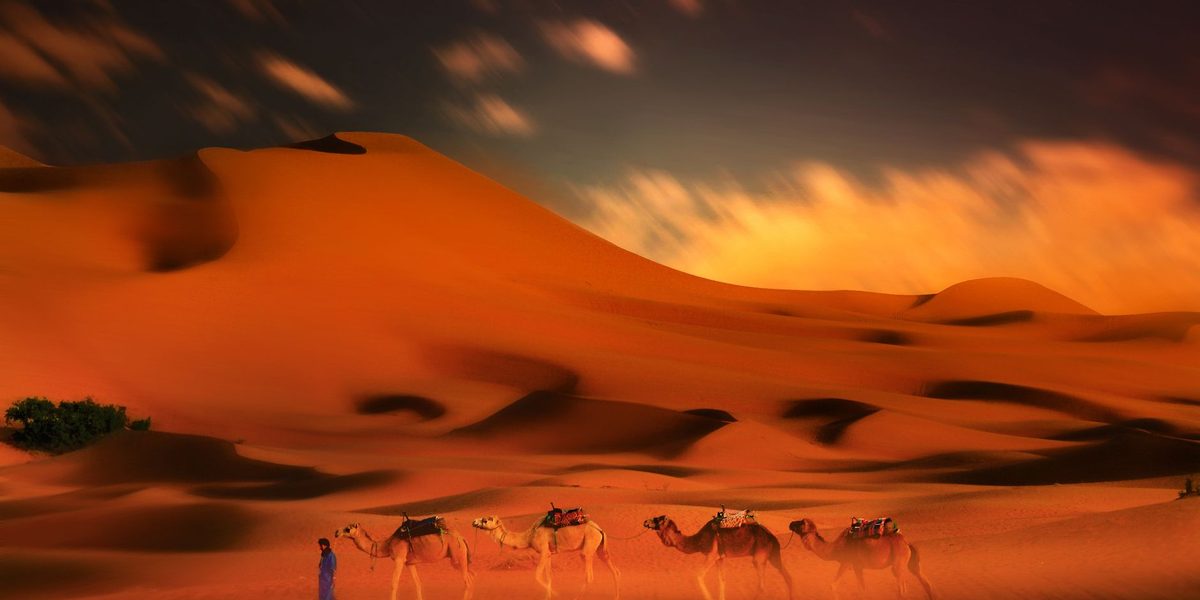
The word desert describes rainfall, not temperature or terrain, and the world's famous deserts differ wildly. The Sahara is the classic image — an area comparable to the entire United States, though its towering sand seas are only part of the story; most of it is gravel plain, rock plateau, and mountain. The Gobi, spanning Mongolia and northern China, is a cold desert: scorching in summer, brutally frigid in winter, more steppe and stone than sand, and historically the corridor of Silk Road caravans.
The Atacama in northern Chile is the driest nonpolar place on Earth, a high-altitude moonscape of salt flats, geysers, and colored lagoons where some weather stations have never recorded rain. The American Southwest — the Mojave, Sonoran, and Chihuahuan deserts along with the canyon country of the Colorado Plateau — is a desert of dramatic rock, iconic cacti, and surprising biodiversity, laced with road-trip infrastructure. The Arabian Desert pairs vast dune fields like the Empty Quarter with a deep tradition of Bedouin culture and, today, easy access from modern cities. Each demands different clothing, transport, and expectations; researching your specific desert matters more than researching deserts in general.
Cultures Built on Scarcity
Deserts are not empty; they are home. The Sahara and Arabia sustained the Bedouin, Tuareg, and other nomadic peoples who mastered camel caravans, celestial navigation, and the moving of entire households between wells. The Gobi shaped Mongolian herding culture, with its round felt gers and seasonal migrations. The Atacama region carries Indigenous Andean traditions thousands of years old, and the American Southwest is the living homeland of Native nations whose pueblos, cliff dwellings, and ceremonies long predate any highway.
What unites desert cultures is an ethic forged by scarcity: water discipline, mobility, deep environmental knowledge, and an almost sacred duty of hospitality. When resources are scarce and distances are lethal, the rule that a stranger must be fed, watered, and sheltered becomes a survival system for everyone. Travelers still feel this today — in the sweet mint tea poured three times in a Saharan camp, in the coffee ceremony of Arabia, in the open door of a Mongolian ger. Receiving such hospitality graciously, accepting what is offered with the right hand, and never treating it as a paid performance is the heart of desert etiquette.
Heat, Cold, and the Desert Day
The desert's defining rhythm is the swing. With little moisture or cloud to hold warmth, a day that soars punishingly hot can be followed by a night near freezing, and desert travelers routinely carry both sun protection and an insulated jacket. High-altitude deserts like the Atacama add thin air and fierce ultraviolet exposure to the equation; altitude can affect anyone regardless of fitness, so ascend gradually, take it easy on arrival, and seek medical advice beforehand if you have any health concerns.
Desert people solved the daily heat long ago: work early, rest through the furnace hours, revive in the evening. Visitors should copy the pattern — hike at dawn, tour in the morning, retreat to shade at midday, and save exploration for late afternoon. Loose, light-colored, long-sleeved clothing outperforms shorts and tank tops, which is why traditional desert dress covers nearly everything. A wide brim or head covering, quality sunglasses, and sunscreen complete the uniform. In cold-desert winters, the problem simply reverses, and layering becomes everything.
Water: The Only Non-Negotiable
Every desert tradition, from caravan routes plotted well-to-well to the courtesy of never refusing a guest a drink, orbits around water, and your planning should too. Dehydration in dry air is sneaky: sweat evaporates instantly, so you rarely feel drenched, and thirst lags behind need. Drink steadily rather than waiting for thirst, and remember that headache, fatigue, dizziness, and irritability are early warnings to rest, shade up, and rehydrate.
- Carry more water than seems reasonable, and split it between containers in case one fails.
- Never pass a reliable refill point without topping up, and never rely on finding water along a route.
- Pair water with food or electrolytes on long, sweaty days; water alone is not the whole answer.
- Keep drinking in cold deserts too — dry winter air dehydrates almost as efficiently as summer sun.
- Tell someone your route and return time before heading into remote country, and keep your vehicle stocked with extra water regardless of plans.
Nights Made of Stars
Ask returning travelers about their desert trip and most will mention the night sky before the dunes. Deserts combine the three ingredients stargazers chase — dry air, high elevation or clear horizons, and distance from city light — and the result can be overwhelming: the Milky Way as a bright band, planets that cast reflections, meteors on an ordinary evening. The Atacama in particular has become a global capital of astronomy, and many desert camps everywhere build their evenings around the sky.
Enjoying it takes almost no equipment, only patience. Let your eyes adapt for a good twenty minutes away from lamps and phone screens, use red light if you need light at all, and lie back rather than craning upward. Moonless nights offer the deepest skies, while full-moon nights transform dunes into silver landscapes worth a walk. Either way, a warm layer makes the difference between a glance and an hour of wonder.
Leave No Trace in a Fragile Place
Deserts look indestructible and are the opposite. Arid soils host living crusts of tiny organisms that stabilize the ground and can take decades to recover from a single boot print or tire track; water sources are lifelines for wildlife and herders alike; and dry air preserves everything, meaning litter and vehicle scars can outlast their makers by generations. Even ancient rock art and ruins survive precisely because so few hands have touched them — a chain visitors should not break.
The principles are simple. Stay on established roads and trails, and camp on durable surfaces like rock, gravel, or previously used sites. Pack out every scrap of waste, including organic waste, which barely decomposes in dry climates. Never contaminate springs, wells, or waterholes with soap or waste, and camp far enough away that animals and herds can still approach. Leave artifacts, potsherds, and rock art untouched and unclimbed. In inhabited deserts, remember that the land is someone's pasture, water source, or sacred ground — hire local guides, ask before photographing people or camps, and let your visit support the communities that keep these places alive.
Final Thoughts
A desert trip is a lesson in respect: for climate, for scarcity, and for the cultures that turned survival into art. Learn which desert you are actually visiting, adopt its ancient schedule of dawn effort and midday rest, treat water as the treasure it is, and stay up at least one night to see what the sky looks like without interference. Travelers who do come home understanding why desert peoples speak of these landscapes not as wastelands, but as home.