The Silk Road is one of history’s most romantic names for one of its most practical inventions: a sprawling web of trade routes that, for well over a thousand years, connected China to the Mediterranean across the mountains and deserts of Central Asia. Travelers today can still walk its most storied cities — Samarkand, Bukhara, Khiva — and stand under turquoise domes that merchants once used as landmarks across the steppe. But to see these places properly, it helps to understand what the Silk Road actually was, what moved along it besides silk, and why its greatest cargo was never goods at all, but ideas. Consider this your grounding before you go.
A Network, Not a Road
The first thing to unlearn is the image of a single highway. There was no one Silk Road; there was a braided network of caravan tracks that split, merged, and shifted with politics, weather, and banditry. Routes ran north of the Tian Shan mountains or south through the Fergana Valley, skirted the terrible Taklamakan Desert along its northern or southern rim, and branched toward India, Persia, and the Volga. The name itself is modern — coined by a nineteenth-century German geographer — and the merchants who worked the routes would not have recognized it.
The second thing to unlearn is the lone trader traveling from China to Rome. Almost nobody made the full journey. Goods moved in relays: a merchant carried cargo a few hundred miles to the next oasis market, sold it, and turned home. Silk might pass through a dozen pairs of hands between a Chinese workshop and a Roman noblewoman, gaining a markup at every exchange. This relay structure explains why the oasis cities of Central Asia grew so spectacularly rich — they were not waypoints on someone else’s journey but the marketplaces where every journey ended and a new one began.
Samarkand: The Crossroads City
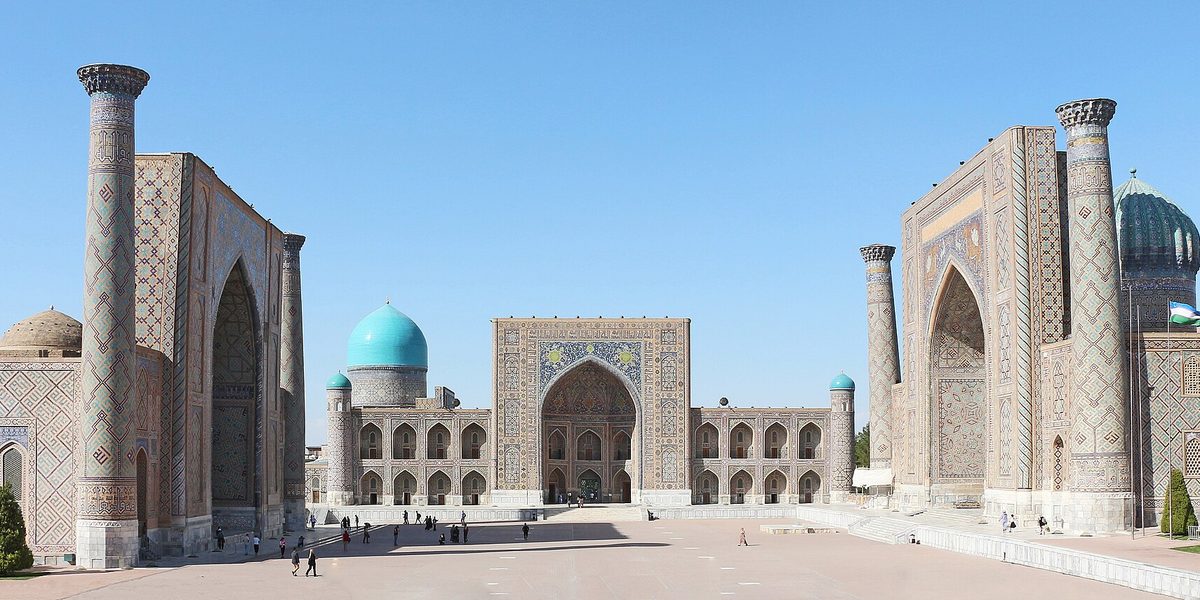
No city wears its Silk Road inheritance more visibly than Samarkand, in modern Uzbekistan. Ancient Sogdian merchants made it a hub long before Alexander the Great arrived and reportedly declared it more beautiful than he had imagined. Its golden age came under Timur, the fourteenth-century conqueror known in the West as Tamerlane, who dragged artisans home from every city he subdued — Persian tilemakers, Syrian glassblowers, Indian stonemasons — and set them to building a capital worthy of an empire.
The result is the Registan, a plaza framed by three monumental madrasas whose facades ripple with turquoise, cobalt, and gold mosaic. Nearby stand the Bibi-Khanym Mosque, built at a scale that pushed medieval engineering to its limits, and Shah-i-Zinda, an avenue of tombs so densely tiled it feels like walking through a jewel box. Gur-e-Amir, Timur’s own mausoleum, rehearses the ribbed azure dome that his descendants would carry to India — look at it and you can see the Taj Mahal’s ancestry. Samarkand’s architecture is the Silk Road’s thesis rendered in tile: wealth from trade, craft from everywhere.
Bukhara: The Scholar’s City
If Samarkand dazzles, Bukhara persuades. Two hours across the desert, it was for centuries one of the intellectual capitals of the Islamic world, a city of scholars, poets, and libraries where the great physician Ibn Sina — known to Europe as Avicenna — began his education. Its old town survives as a living whole rather than a set of restored monuments: a warren of lanes where people still trade under domed market crossings built centuries ago for exactly that purpose.
The Kalyan Minaret, a tapering brick tower ornamented with band after band of geometric pattern, so impressed Genghis Khan that he ordered it spared while the rest of the city burned. The Po-i-Kalyan complex around it, the fortress walls of the Ark, the tranquil pool and mulberry trees of Lyab-i-Hauz, and the tiny, jewel-like Samanid mausoleum — one of the oldest surviving buildings in Central Asia — reward slow wandering. Bukhara is best experienced at walking pace, in the hour before sunset when the brick turns honey-colored and swallows circle the minaret.
Caravanserais and the Rhythm of the Road
The infrastructure that made the whole system work was the caravanserai — a fortified inn spaced roughly a day’s camel journey apart, which is why ruins of them still dot the routes at intervals of twenty to thirty miles. Behind a single defensible gate, a courtyard offered water, fodder, storage for goods, and rooms for merchants. But a caravanserai was never just a motel for camels. It was a nightly news exchange where traders swapped information about prices, routes, wars, and weather in a dozen languages.
Life on the road moved to a slow, deliberate rhythm. Caravans traveled in the cool of early morning, rested through the heat, and covered perhaps fifteen to twenty miles a day. Camels — the two-humped Bactrian variety, shaggy enough for mountain winters — could carry heavy loads and endure days between wells. The professionals who managed these logistics for centuries were often Sogdians, an Iranian-speaking people from the Samarkand region whose language became the lingua franca of the eastern routes, and whose letters, preserved by desert dryness, give historians vivid glimpses of ordinary merchant life: complaints about business partners, instructions to family, gossip about distant markets.
What the Caravans Really Carried
Silk moved west, certainly — lightweight, durable, and fabulously valuable, it was the perfect long-distance cargo. But the manifests were far richer than the name suggests.
- Goods: Chinese porcelain and paper; Persian glass and silverwork; Indian spices, gems, and cotton; Central Asian horses, prized by Chinese emperors; furs and amber from the north; dyes, medicines, and dried fruit in every direction.
- Technologies: Papermaking spread west from China through Samarkand, which became famous for its paper mills — a transfer that would eventually make Europe’s print revolution possible. Silk cultivation itself, gunpowder, and the stirrup traveled the same corridors.
- Beliefs: Buddhism rode the caravan routes from India into China, leaving cave monasteries along the way. Islam moved east into Central Asia, Nestorian Christianity reached the Chinese court, and Zoroastrian and Manichaean communities flourished in the oasis towns.
- Foods and music: Grapes, walnuts, sesame, and noodle cookery crossed borders alongside instruments — the lute family alone colonized the entire landmass in different forms.
This is the Silk Road’s deepest lesson: trade routes are idea routes. Every camel load of silk subsidized the movement of religions, alphabets, melodies, and recipes. The disease that devastated the medieval world traveled the same paths — a reminder that connection has always carried risk along with riches.
Walking the Route Today
Modern travelers experience the Silk Road most vividly in Uzbekistan, where Samarkand, Bukhara, and the walled museum-city of Khiva form a classic overland arc, now conveniently linked by fast trains that cover in hours what caravans crossed in weeks. Beyond Uzbekistan, the routes continue: the mountain passes and yurt camps of Kyrgyzstan, the Pamir Highway through Tajikistan, the desert ruins of Merv in Turkmenistan, and the western Chinese oasis towns around the Taklamakan.
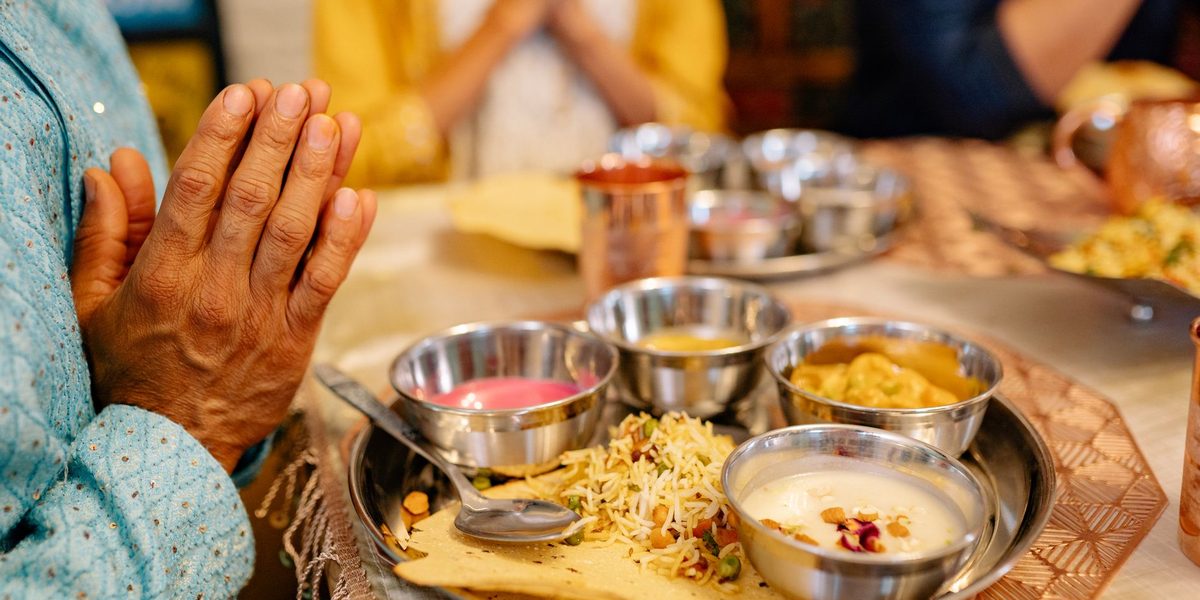
Some practical texture helps. Central Asian hospitality is serious business — expect green tea poured in small bowls, offered and refilled endlessly, and bread treated with near-sacred respect: never place it upside down and never throw it away casually. Plov, the region’s rice-carrot-and-lamb centerpiece, is both daily food and festival dish, and being invited to share it is an honor worth accepting. In bazaars, gentle bargaining is normal for crafts and souvenirs but not for food. Dress is generally relaxed in Uzbek cities, though modest clothing is right for mosques and mausoleums, and a headscarf is sometimes appropriate for women at active shrines. A few words of greeting — salom, or the Russian zdravstvuyte — open doors everywhere.
Final Thoughts
The Silk Road ended not with a dramatic collapse but with a slow rerouting, as ocean shipping undercut caravan economics and empires turned inward. Yet the cities it built are still there, still trading, still pouring tea for strangers. To visit Samarkand or Bukhara with the history in mind is to see more than beautiful tilework: it is to stand in the marketplaces where East and West spent a millennium meeting, haggling, and quietly changing each other. That exchange — not the silk — is what the road was really for, and it is what a thoughtful traveler inherits simply by showing up curious.