India is less a country than a continent wearing a single passport. First-time visitors often prepare for it the way they would for any destination — a packing list, a few landmarks, a food warning or two — and then find themselves overwhelmed within hours of landing. The travelers who thrive are the ones who prepared their expectations, not just their luggage. This is a guide to the concepts, customs, and rhythms worth understanding before your first trip, so that India's famous intensity becomes fascination rather than friction.
One Name, Many Indias
The single most important thing to grasp is India's scale of diversity. The country recognizes nearly two dozen official languages, and hundreds more are spoken. Scripts change between states, as do cuisines, clothing, festivals, and even the shape of the tea glass. Kerala's backwaters, coconut curries, and communist murals have little in common with Rajasthan's desert forts and mirrored textiles; the Himalayan north feels like a different world from the temple towns of Tamil Nadu; Mumbai and Kolkata are as distinct from each other as any two capitals in Europe.
Practically, this means two things. First, do not try to see India in one trip — pick a region and let it be enough. Two weeks in the south, or a focused loop through Rajasthan, will teach you more than a whistle-stop tour of the whole map. Second, hold your generalizations loosely. Whatever you learn as a rule in one state may be gently contradicted in the next, and locals enjoy explaining the differences.
The Head Wobble and Other Communication Styles
Few gestures confuse visitors more than the Indian head wobble — a smooth side-to-side tilt that is neither a nod nor a shake. Depending on speed, context, and expression, it can mean yes, okay, I understand, I agree, or simply I am listening. With time you will read it naturally, and probably catch yourself doing it. When you genuinely need certainty, ask an open question rather than one inviting yes or no.
Communication generally leans indirect and relentlessly polite. A flat no is rare; you may instead hear that something is possible, or that you should check tomorrow, which often means no. This is not dishonesty but a cultural preference for preserving goodwill. The traditional greeting of namaste, palms pressed together, is always appreciated, though handshakes are common in cities. Use your right hand for giving, receiving, and eating — the left is traditionally considered unclean — and avoid pointing the soles of your feet at people or religious objects, as feet are regarded as the lowest part of the body.
Eating with Your Hands, and Loving It
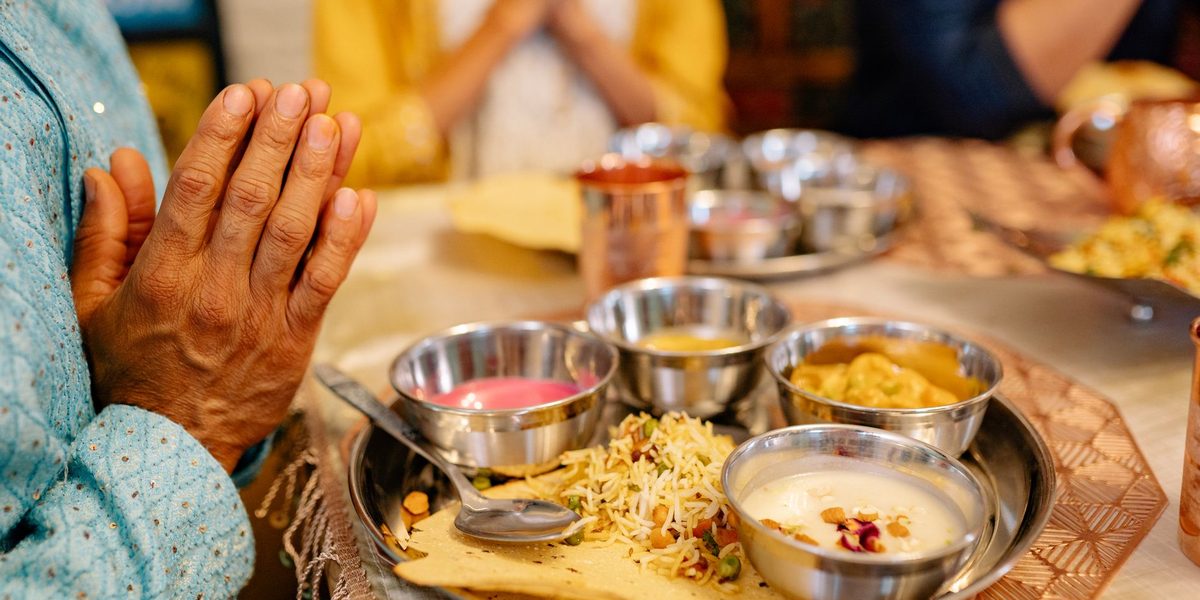
Across much of India, food is eaten with the right hand, and doing so is considered part of the pleasure — a saying holds that eating with your hands lets you taste with your fingers. The technique is real: use the tips of the fingers rather than the whole palm, tear roti or naan with one hand, and use pieces of bread or mounds of rice to scoop. In the south, meals often arrive on a banana leaf or as a thali, a platter of small dishes meant to be mixed with rice in stages. Wash your hands before and after; nearly every restaurant has a sink in the dining room for exactly this purpose.
Nobody will scold a visitor for requesting a spoon, and cutlery is standard in many urban restaurants. But trying the traditional way, at least once, is quietly appreciated and genuinely changes the meal. A few table habits to know: sharing food is normal but taking a bite from someone else's plate or a sip from a shared bottle involves not touching it to your lips; refusing offered food entirely can disappoint a host, so accept at least a taste; and expect sweetness, spice, and generosity in quantities you did not order.
Temples, Mosques, and Sacred Spaces
Religion in India is not confined to buildings — it spills into streets, rivers, roadside shrines, and daily schedules — but buildings have rules. Shoes come off before entering temples, mosques, and gurudwaras, and often before homes; look for the rack or the pile of sandals and add yours. Dress modestly, covering shoulders and knees. Many gurudwaras and some temples require head coverings, and scarves are usually available at the entrance. Some Hindu temples restrict inner sanctums to Hindus; signage or an attendant will make this clear, and the restriction should be respected without argument.
Inside, move clockwise around shrines where others do, keep your voice low, and never touch idols, offerings, or worshippers. Ask before photographing anything or anyone, and assume the answer is no inside sanctums. If a priest offers you prasad — blessed food — receive it with the right hand. In mosques, avoid visiting during prayer times unless invited, and note that some areas are reserved for men or for women. None of this is meant to exclude visitors; sacred spaces across India are remarkably welcoming to respectful outsiders.
Bargaining Without Battling
In markets, bazaars, and with auto-rickshaws that decline to use a meter, bargaining is expected — it is a social ritual, not a confrontation. Fixed-price shops, malls, and grocery stores are exactly what they say, so read the room before negotiating. Where haggling applies, keep it light: smile, counter well below the opening price, expect to meet somewhere in the middle, and be willing to walk away, which is often when the real price appears.
- Decide what the item is worth to you before you start, and stop when you reach it.
- Keep small notes handy; making change can become part of the negotiation.
- Never bargain hard and then not buy at your accepted price — agreeing seals the deal.
- For rickshaws and taxis, agree on the fare before getting in, or insist on the meter where meters are used.
- Remember the sums involved are often small for you and meaningful for the seller; win the game, not the war.
Traffic, Noise, and the Art of Flow
Indian traffic terrifies newcomers and then, strangely, starts to make sense. Lanes are suggestions, horns are language — a honk usually means I am here, not I am angry — and cows genuinely do have the right of way. Crossing a street is done at a steady, predictable walk, ideally beside a local; traffic flows around confidence and punishes hesitation. Distances deceive: a hundred kilometers can take three hours, so plan fewer places and more time. Trains remain one of the great Indian experiences, with classes ranging from air-conditioned calm to gloriously social sleeper cars, and they reward booking ahead.
Accept early that noise, crowds, and sensory intensity are features, not malfunctions. Build recovery time into every day — a quiet courtyard café, a garden, an afternoon rest — and treat delays as part of the itinerary. The visitors who struggle most are the ones defending a schedule; the happiest ones budget slack and spend it freely.
Dressing for Comfort and Respect
Dress norms vary by region and city, but modest, loose, breathable clothing serves everywhere. For all travelers, lightweight cotton or linen covering shoulders and knees handles both the climate and cultural expectations; a scarf is the single most useful item you can carry, doubling as head cover, sun shield, and shoulder wrap. Urban districts and beach destinations run more relaxed, while small towns and religious sites run conservative. Locals rarely comment on visitors' clothing, but dressing thoughtfully changes how you are received — more respect, easier conversations, better prices.
Final Thoughts
India does not ask to be conquered in one trip; it asks to be met with patience, humor, and an open hand — preferably the right one. Learn the wobble, take off your shoes, eat with your fingers once, bargain with a smile, and surrender the illusion of a fixed schedule. Do that, and the country's overwhelming first impression resolves into what returning travelers already know: one of the most rewarding places on earth to be a guest.