Stand in the oil aisle of any grocery store and you face a wall of choices: olive, canola, avocado, peanut, sunflower, coconut, sesame, and more, each label whispering that it is the healthy one, the versatile one, the chef's secret. Meanwhile, cooking advice tosses around the phrase smoke point as if everyone was born knowing what it means. This guide untangles the whole subject. By the end, you will understand what actually happens when oil overheats, why some oils cost triple what others do, and how to match any oil in your pantry to the technique you are using tonight.
What a Smoke Point Actually Is
Every cooking oil has a temperature at which it stops merely shimmering and starts visibly breaking down, sending up wisps of acrid bluish smoke. That threshold is the smoke point. What is happening chemically is decomposition: the fat molecules themselves begin to fracture, and the fragments — free fatty acids, glycerol breaking down into a harsh compound called acrolein, and assorted burnt-tasting byproducts — become airborne. Acrolein is the thing that stings your eyes and gives overheated oil its unmistakable sharp smell.
Why should a cook care? Three reasons. First, flavor: once oil passes its smoke point, it develops scorched, bitter notes that soak into whatever you are cooking. Second, the delicate compounds that make a good oil taste good are destroyed by that kind of heat, so you paid for flavor and then burned it off. Third, smoking oil is a fire risk — heat it far enough beyond the smoke point and it can eventually ignite. The practical rule is simple: choose an oil whose smoke point comfortably exceeds the temperature your technique requires, and if a pan of oil ever billows smoke, take it off the heat, let it cool, wipe it out, and start again.
Refined Versus Unrefined: The Real Dividing Line
People often talk as if smoke point depended mainly on which plant the oil came from, but the bigger factor is how the oil was processed. An unrefined oil is essentially pressed and bottled. It keeps its color, aroma, and character — along with tiny particles of plant matter, free fatty acids, and delicate compounds. Those impurities are exactly what make unrefined oils delicious, and exactly what makes them fragile: the particles and free fatty acids begin scorching at relatively low temperatures, dragging the smoke point down.
A refined oil has been filtered, treated, and often deodorized to strip those impurities out. What remains is cleaner, paler, more neutral in flavor, and far more heat-stable, with a dramatically higher smoke point. The same crop can yield both: an unrefined, toasty version meant for drizzling and a refined version built for the fryer. Neither is better in the abstract — they are different tools. The unrefined bottle is a finishing ingredient that happens to pour; the refined bottle is heat-resistant cooking equipment that happens to be liquid.
Neutral Versus Flavorful: The Other Axis
The second way to sort oils is by how much they taste like something. Neutral oils — canola, most vegetable blends, refined sunflower, grapeseed, refined peanut, refined avocado — are deliberately quiet. They carry heat, crisp surfaces, and let the food's own flavor lead. Flavorful oils bring a personality of their own: extra-virgin olive oil's grassy pepperiness, toasted sesame oil's deep nuttiness, unrefined coconut oil's tropical sweetness, walnut oil's delicate richness.
Thinking in these two axes — refined or unrefined, neutral or characterful — turns the entire oil aisle into a simple grid. High-heat cooking wants refined and usually neutral. Finishing and dressing want unrefined and flavorful. A gentle sauté sits in the middle and tolerates almost anything. Once you place a bottle on that grid, you know what it is for, regardless of which plant it came from.
Matching the Oil to the Technique
Different cooking methods make very different demands on fat, and this is where the theory becomes dinner.
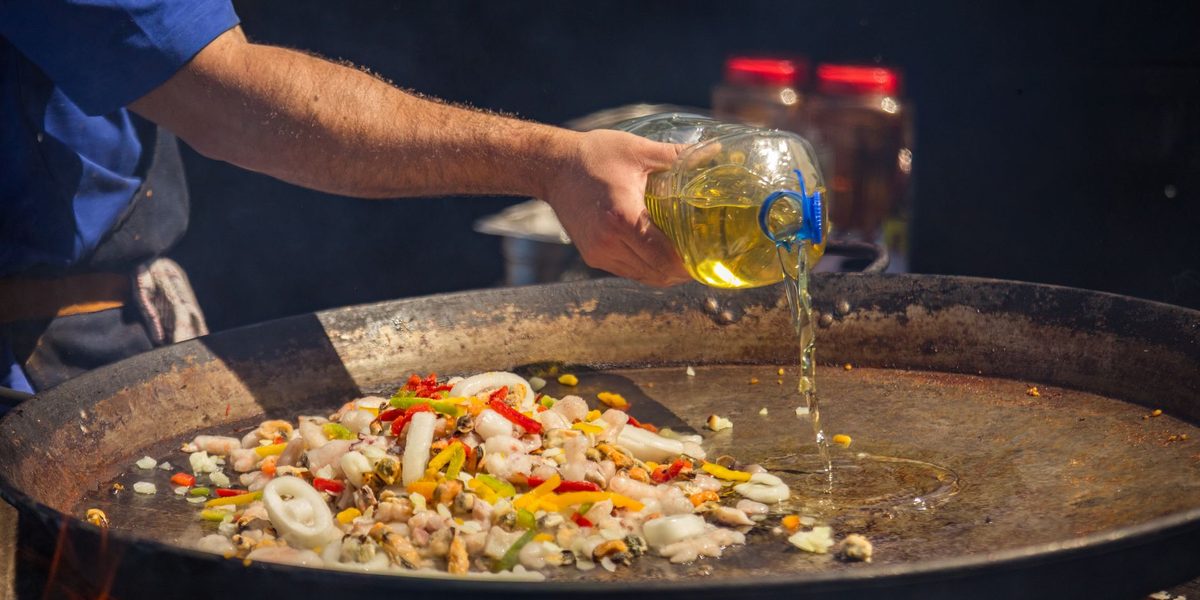
- Searing and stir-frying are the most punishing jobs, with pans running extremely hot. Use a refined, high-smoke-point oil — refined avocado, refined peanut, canola, or a general vegetable oil — so the oil survives long enough to brown the food instead of burning beneath it.
- Deep frying holds oil at a high temperature for a long time, so stability matters as much as smoke point. Refined neutral oils are the standard choice, and the oil should be deep enough and hot enough that food crisps rather than soaks.
- Everyday sautéing happens at moderate temperatures that most oils handle easily, including ordinary olive oil. Pick based on the flavor you want in the dish.
- Roasting tolerates a wide range; toss vegetables with a sturdy oil, and save the precious finishing oils for after the food leaves the oven.
- Dressings, drizzles, and dips never see heat, so this is where unrefined, characterful oils belong — extra-virgin olive oil on salads and soups, toasted sesame stirred in at the end of a stir-fry, nut oils over roasted vegetables.
- Baking usually wants a neutral oil that will not argue with vanilla and butter flavors, though olive oil cakes prove a flavorful oil can be the point when chosen deliberately.
Notice the pattern: heat tolerance governs the hot jobs, and flavor governs the cold ones. Nearly every oil decision reduces to those two questions.
The Olive Oil Myth, Untangled
The most persistent piece of oil folklore says you should never cook with extra-virgin olive oil because of its low smoke point. The truth is more interesting. Extra-virgin olive oil's smoke point is moderate, not tiny — comfortably above the temperatures of typical home sautéing. It is also unusually rich in natural antioxidants and dominated by monounsaturated fat, both of which help it resist breaking down at sustained moderate heat. For ordinary pan cooking, extra-virgin olive oil performs perfectly well, and Mediterranean kitchens have cooked with it daily for generations.
The real arguments for reaching past it at high heat are practical rather than fearful. Ripping-hot searing and deep frying can exceed its comfort zone, and a refined neutral oil handles those jobs better. Just as importantly, high heat destroys the very aromatics that justify extra-virgin oil's price — searing a steak in a fine finishing oil is like using perfume as lighter fluid. A sensible household compromise is two bottles: a moderately priced extra-virgin for cooking where its flavor survives, and a special one reserved for drizzling raw, with a refined neutral oil on hand for the hottest work.
Storage, Rancidity, and Why Oil Goes Stale
Oil does not spoil the way milk does, but it degrades in a slower, sneakier way: rancidity. Exposure to oxygen, light, and heat gradually oxidizes the fat molecules, producing stale, waxy, crayon-like or cardboard-like flavors. Rancid oil is not dramatically dangerous in normal amounts, but it tastes flat and off, and it quietly sabotages everything you cook with it. Many people have simply never tasted truly fresh oil, because the bottle on their counter went stale months ago.
Defense is easy. Buy sizes you will finish within a few months rather than giant jugs of delicate oil. Keep bottles tightly capped in a cool, dark cupboard — not in the bright, warm strip beside the stove, which is the worst spot in the kitchen for them. Dark glass or tins protect better than clear plastic. Fragile nut and seed oils keep best in the refrigerator; they may turn cloudy when cold, but they clear again at room temperature, unharmed. And trust your nose: fresh oil smells pleasant or like nothing at all, while rancid oil smells like old crayons or stale nuts. When in doubt, sniff before you pour.
Final Thoughts
Cooking oil stops being confusing the moment you ask two questions of every bottle: how much heat can it take, and how much flavor does it bring? Refined, neutral oils are your workhorses for searing and frying; unrefined, characterful oils are your seasonings for finishing and dressing; and a good everyday olive oil covers the broad middle. Keep them cool, dark, and reasonably fresh, respect the smoke point, and the wall of bottles at the store becomes what it always should have been — a toolbox, with a right tool for every job.