Walk into any classic culinary school and one of the first lessons on the syllabus is the same: the five mother sauces. It sounds grand, almost mythical, but the idea behind it is refreshingly practical. French cooks noticed long ago that the enormous universe of sauces — the cheese sauce on your macaroni, the gravy on your roast, the silky yellow ribbon over your eggs — nearly all trace back to a handful of base techniques. Master those bases, the thinking goes, and you can build almost anything on top of them.
Where the Framework Comes From
The mother sauce system comes from the great codifiers of French cuisine, who organized sprawling kitchen traditions into teachable categories. Their insight was that sauces are not hundreds of separate recipes but variations on a few core methods. A base liquid, a thickening strategy, and a flavor profile define a family; everything else is decoration. The five families that survived this sorting process are béchamel, velouté, espagnole, tomate, and hollandaise.
The word choice matters. These are called mother sauces because each one gives birth to daughter sauces — the base plus one or two additions becomes something new with its own name. That family-tree structure is the real gift of the system. Instead of memorizing fifty recipes, you learn five techniques and a logic for extending them.
First, Understand the Roux
Before meeting the sauces themselves, you need to meet the technique that powers three of them: the roux. A roux is simply flour cooked in fat, usually butter, in roughly equal amounts. Cooking the flour does two things. It coats the starch granules in fat so they disperse smoothly into liquid instead of clumping, and it cooks away the raw, pasty taste of uncooked flour.
When hot liquid meets a roux and the mixture simmers, the starch granules swell and burst, releasing long starch molecules that tangle through the liquid and thicken it into a sauce that coats a spoon. How long you cook the roux changes its character. A pale, barely colored roux thickens powerfully and tastes neutral. A blond roux, cooked a few minutes longer, adds a faint nuttiness. A brown roux, cooked until deeply toasted, brings rich flavor but loses some thickening power, because heat gradually breaks down the starch. This single technique — fat, flour, liquid, simmer — is the backbone of an enormous amount of Western cooking.
Béchamel: The Milk Sauce
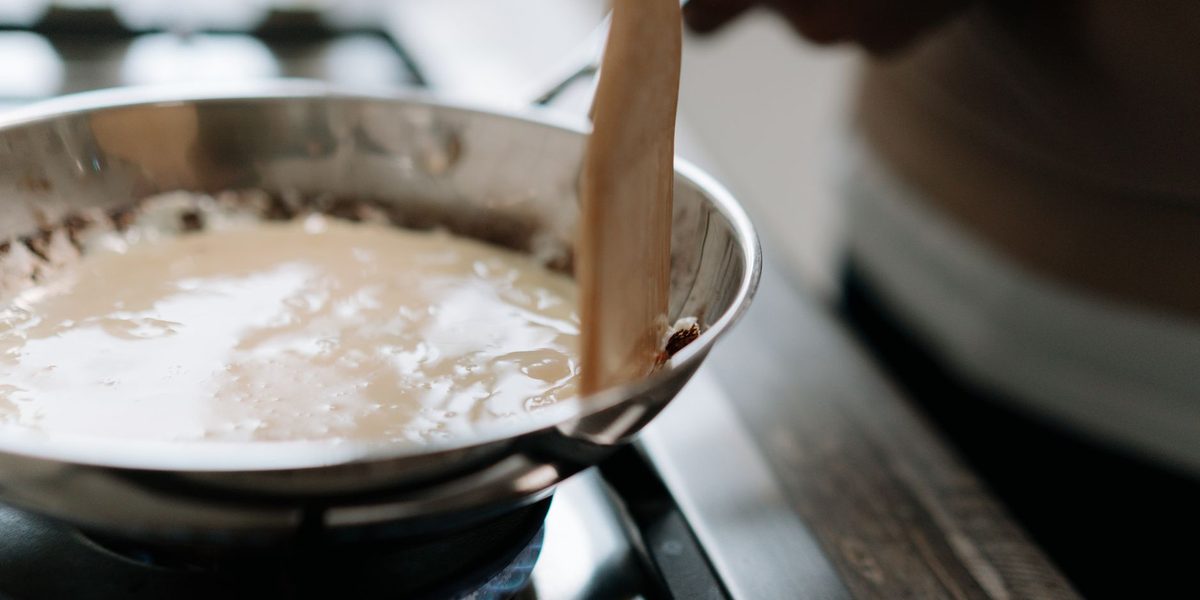
Béchamel is the gentlest of the mothers: a white roux whisked into milk and simmered until smooth and velvety. Because milk is mild, béchamel is essentially a blank canvas with a creamy texture, often seasoned with just salt, white pepper, and a whisper of nutmeg. It is the easiest mother sauce for a beginner because it requires no stock, only pantry staples.
Its daughters show how the family logic works. Add grated cheese and béchamel becomes Mornay — the ancestor of every great macaroni and cheese. Steep onion and clove in the milk first and you get soubise-style depth. Layer it into lasagna or a gratin and it becomes the creamy binder that holds the dish together. Anytime a recipe says white sauce, it is speaking béchamel.
Velouté: Stock's Silky Cousin
Velouté follows the exact same method as béchamel but swaps milk for a light stock — traditionally chicken, fish, or veal. The name comes from the French word for velvet, which tells you everything about the target texture: a smooth, flowing sauce with the savory character of whatever stock built it.
Velouté rarely appears on a plate under its own name; it is a stepping stone. Enrich a velouté with cream and egg yolk and you have allemande. Build a fish velouté with white wine and you are heading toward classic seafood sauces. Finish a chicken velouté with cream and mushrooms and you have suprême, the elegant sauce draped over poached poultry. If you have ever made a pot pie filling or a creamy gravy from pan drippings, stock, and flour, you have made a velouté in spirit.
Espagnole: The Deep Brown Workhorse
Espagnole is the brooding member of the family: a brown roux combined with dark, roasted stock, tomato, and mirepoix — the aromatic trio of onion, carrot, and celery — then simmered and skimmed for a long time. The result is a deeply savory brown sauce that is intentionally too intense to serve as-is. It is a building block, not a finished product.
Its most famous daughter is demi-glace, made by combining espagnole with more stock and reducing it until it is glossy, concentrated, and almost sticky with body. From demi-glace flow the great steak and roast sauces: add red wine and shallots for one classic, mushrooms and herbs for another, a splash of Madeira for a third. Every rich brown gravy and pan sauce you have ever loved is playing in espagnole's key, even when it takes shortcuts.
Tomate: More Than Pasta Sauce
The French mother sauce tomate is heartier than the bright Italian tomato sauces most of us picture. The classical version simmers tomatoes slowly with salt pork, aromatic vegetables, stock, and sometimes a roux, building a rounded, savory sauce with real depth. Modern kitchens usually skip the roux, letting the tomatoes' own flesh and a long simmer provide the body.
What earns tomate its seat among the mothers is its versatility. It anchors braises, moistens baked dishes, becomes the base for spiced and smoky variations, and pairs with nearly every protein and starch in the pantry. The lesson inside it is about reduction and balance: tomatoes are acidic and watery when raw, and time on the stove transforms that sharpness into sweetness and body. Understanding that arc — raw, bright, and thin becoming deep, sweet, and thick — is a skill that transfers to countless dishes.
Hollandaise: The Emulsion Outlier
Hollandaise breaks the pattern. There is no roux and no simmering liquid; instead, it is an emulsion — a stable mixture of two things that normally refuse to combine, in this case melted butter and water-based lemon juice, held together by egg yolks. The yolks contain molecules that grip fat on one side and water on the other, letting them coax butter into billions of microscopic droplets suspended in a silky, pourable cloud.
The technique is a balancing act. Too much heat and the yolks scramble; too little and the sauce never thickens; add the butter too fast and the emulsion breaks into a greasy puddle. That fragility is exactly why hollandaise is on the syllabus — it teaches heat control and patience. Its most famous daughter is béarnaise, sharpened with tarragon, shallot, and a vinegar reduction, the traditional partner to steak. Even homemade mayonnaise is a cold cousin, built on the same emulsion principle.
A Framework, Not a Rulebook
It is tempting to treat the five mothers as commandments, but professional cooks rarely do. Plenty of great sauces live outside the system entirely — vinaigrettes, salsas, pan reductions, yogurt sauces, butter emulsions. The value of the framework is not that it covers everything; it is that it organizes your thinking. Every sauce answers the same three questions: what is the liquid, what gives it body, and what gives it flavor?
- Béchamel teaches that starch can thicken a mild dairy base into a canvas.
- Velouté teaches the same move with savory stock.
- Espagnole teaches that browning and long reduction create depth.
- Tomate teaches that some ingredients can thicken and flavor a sauce all by themselves.
- Hollandaise teaches that fat and water can be persuaded into silk with the right emulsifier.
Once you see those five principles, restaurant menus and cookbook recipes stop looking like magic tricks and start looking like variations on themes you already know.
And you do not need to simmer stock for hours to use the framework at home. Start with béchamel, since it needs only butter, flour, and milk, and turn it into a cheese sauce by whisking in a handful of grated cheese off the heat. Next time you roast a chicken, make a quick pan velouté: sprinkle flour into the drippings, cook it briefly, whisk in stock, and simmer. When a tomato sauce tastes harsh, remember tomate's lesson and give it more time to reduce and mellow. When a creamy sauce breaks, think like a hollandaise cook — lower the heat, add liquid slowly, and whisk constantly. The deeper habit is diagnostic. Too thin? You need more starch, more reduction, or more emulsified fat. Too dull? You need acid, salt, or browning. Too heavy? Loosen it with the base liquid. The mother sauce system hands you that vocabulary.
Final Thoughts
The five mother sauces endure not because French cuisine owns the truth about cooking, but because the framework turns sauce-making from memorization into understanding. Learn one roux, one emulsion, and one slow tomato simmer, and you carry the DNA of hundreds of sauces in your hands. Start with the mother that fits tonight's dinner, and let the daughters follow.